

Summary & Context
Adolescent smoking remains a critical public health challenge worldwide. The transition from childhood to young adulthood represents a vulnerable developmental window characterized by identity exploration, sensation-seeking, and heightened sensitivity to social dynamics. While traditional cigarette consumption among youth has fluctuated due to anti-tobacco policies, the rapid rise of alternative nicotine delivery systems (e.g., e-cigarettes, vapes) has reshaped youth nicotine intake patterns.
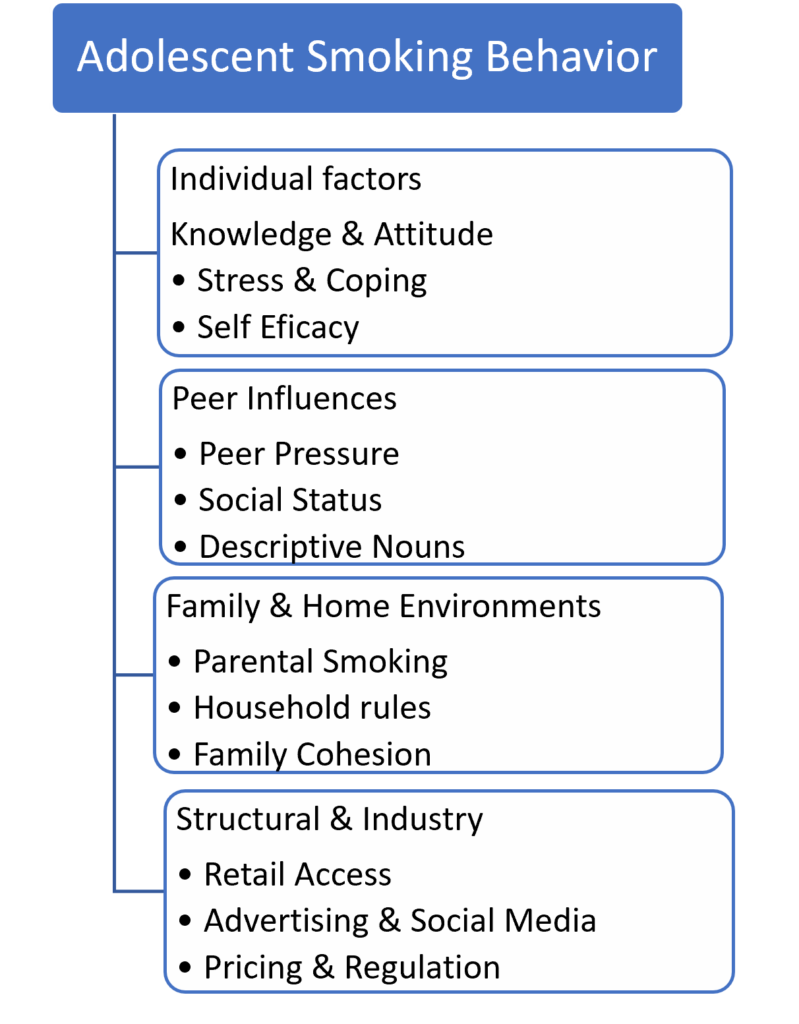
Understanding youth smoking requires a multidimensional socio-ecological framework that accounts for individual psychological states, peer pressure, parental dynamics, marketing exposure, and regulatory access.
Core Determinants Framework
Selected Research Articles for Seminar Discussion
| Theme | Article Reference & Key Focus | Core Findings / Theoretical Angle |
| Cognitive & Behavioural Factors | Social Cognitive Theory (SCT) in Adolescent Tobacco Use (e.g., Frontiers in Public Health, 2023) | Evaluates how positive outcome expectations (e.g., stress relief, weight control) and self-efficacy determine smoking experimentation vs. habitual use. |
| Peer & Social Dynamics | Peer Influence & Descriptive Norms in Youth Smoking (e.g., BMC Public Health / Journal of Public Health) | Shows that perceived peer acceptance and friend group smoking status are among the strongest single predictors of youth initiation. |
| Family & Domestic Environment | Parental Smoking and Domestic Rules (e.g., JKEP / Public Health Studies) | Examines how parental smoking modelling increases adolescent smoking likelihood significantly (Odds Ratios typically between 1.4x to 2.8x). |
| Policy, Retail & Digital Exposure | Determinants of Youth Tobacco Access & Marketing (e.g., Journal of Global Research in Public Health) | Analyses how proximity to tobacco retailers, low enforcement of age limits, and targeted social media marketing facilitate early access. |
Key Questions for Class Discussion
Section A: Psychological & Individual Drivers
- Knowledge vs. Behaviour: Most adolescents are aware that smoking causes severe health risks. Why does knowledge alone fail to prevent smoking experimentation?
- Mental Health & Coping: How does stress or emotional distress contribute to nicotine initiation, and what alternative coping mechanisms could school programs offer?
Section B: Peer & Parental Influences
- Descriptive Norms: Adolescents often overestimate how many of their peers smoke. How can “social norm correction” campaigns be designed effectively in schools?
- Parental Role Models: Should smoking prevention programs target parents as much as students? What strategies work when an adolescent lives with a parent who smokes?
Section C: E-Cigarettes, Marketing & Policy
- The Vape Transition: How do the marketing tactics for e-cigarettes (Flavors, discreet devices, social media ads) differ from traditional tobacco ads, and how do they alter adolescent perception?
- Policy Enforcement: Retail access remains a major driver. Between strict retail penalties, taxation, and school-based bans, which policy intervention yields the highest impact?